
Quick answer: Choose organic vs inorganic pigments for plastics and masterbatch by matching the exact pigment grade to the polymer, peak melt temperature, residence time, required opacity, outdoor exposure, migration risk and regulatory market. Organic pigments usually offer brighter chroma and higher tinting strength, while inorganic pigments often provide stronger opacity, heat resistance and weather durability. Neither family is universally better. The lowest-risk solution may be one pigment, a blended color system, or different formulations for different polymers.
Masterbatch buyers frequently compare organic and inorganic pigments as if the decision were a simple choice between bright color and durability. That comparison is useful as a first screen, but it is not enough for purchasing approval. Pigment chemistry, particle form, surface treatment, concentration, carrier resin, additives, processing history and final wall thickness all influence the observed result.
This guide gives purchasing, technical and quality teams a practical framework for comparing organic vs inorganic pigments for plastics. It covers heat stability, migration, dispersion, opacity, color strength, weathering, warpage, compliance, cost-in-use and supplier qualification. The goal is a repeatable masterbatch trial and a technically complete quotation request.
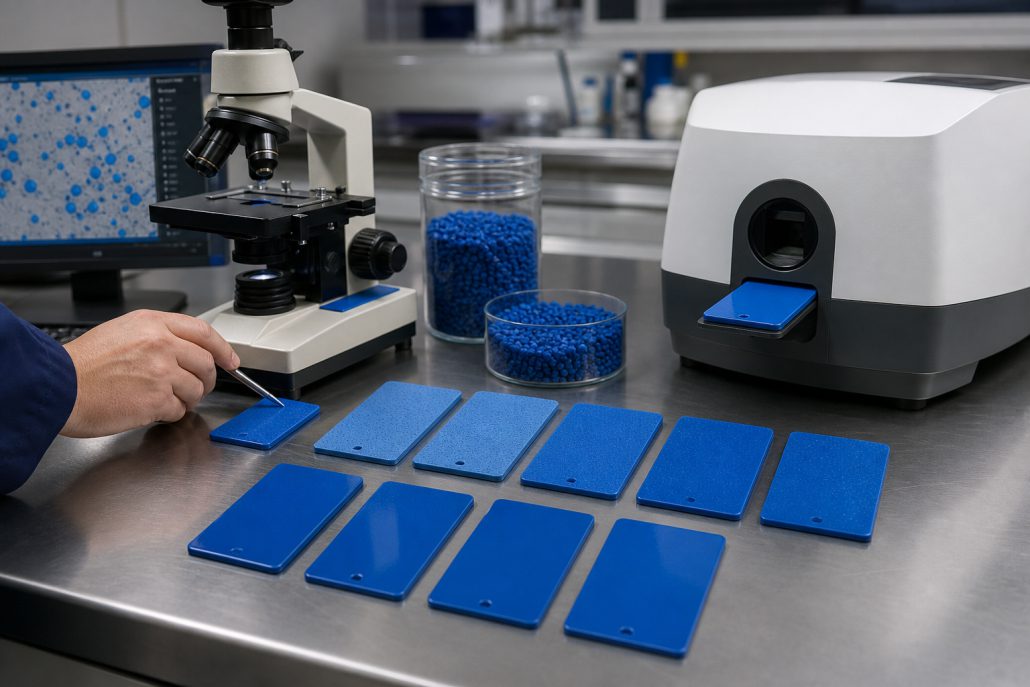
What is the basic difference between organic and inorganic pigments?
Organic pigments are carbon-based colorants designed to remain insoluble in the application medium. Important commercial families include phthalocyanines, quinacridones, diketopyrrolopyrroles, benzimidazolones, isoindolinones and selected azo pigments. Their molecular and crystal structures produce strong, often highly saturated colors. Different crystal forms or surface treatments of the same Color Index pigment can behave differently in a polymer.
Inorganic pigments are mineral or metal-containing solids such as iron oxides, ultramarines, chromium oxide green, titanium dioxide and mixed metal oxide pigments. They are often valued for opacity, thermal robustness, light stability and dimensional reliability. Performance varies widely within the group; an iron oxide, ultramarine and complex inorganic color pigment should not be treated as interchangeable.
The terms describe broad chemical families, not guaranteed performance levels. A high-performance organic pigment can outlast a weak inorganic colorant in a specific exposure, while a suitable inorganic pigment can survive a processing temperature that decomposes an unsuitable organic grade. Selection must be based on grade-specific data and application trials.
Organic vs inorganic pigments for plastics: comparison table
| Selection factor | Organic pigments | Inorganic pigments | What the buyer should verify |
|---|---|---|---|
| Color character | Often bright, clean and highly saturated | Often earthier or more opaque; some complex grades offer clean shades | Full shade, tint, transparency and target Delta E |
| Color strength | Frequently high, allowing low use levels | Usually lower per unit mass for colored grades | Cost at equal final color, not equal pigment dosage |
| Opacity | Many grades are transparent or semi-transparent | Many grades provide stronger hiding | Wall thickness, substrate and TiO2 content |
| Heat stability | Ranges from moderate to excellent by chemistry and polymer | Often strong, but exceptions and shade changes exist | Peak melt temperature, residence time and multiple heat histories |
| Migration and bleeding | Grade-dependent and critical in flexible or plasticized polymers | Generally low migration because of mineral character | Contact materials, plasticizers, heat and end-use conditions |
| Light and weather fastness | Ranges widely; high-performance grades can be excellent | Often strong, especially suitable oxide and mixed-metal grades | Full shade versus tint, UV exposure and stabilizer package |
| Dispersion | High surface area can require careful wetting and shear | Higher density and hard particles may affect processing and wear | Filter pressure, film defects, specks and color development |
| Dimensional effects | Some grades can influence polyolefin crystallization and warpage | Often lower nucleating influence, but must still be tested | Shrinkage, warpage and molding conditions |
| Cost pattern | Higher price per kilogram but often lower dosage | Lower or moderate price for many grades but higher loading | Total cost per accepted part |
This table is a screening tool. It should lead to a shortlist, not a purchase order. Request test conditions and compare supplier data against a controlled internal reference.
Organic vs inorganic pigments for plastics: start with the polymer
The same pigment can perform differently in polyethylene, polypropylene, flexible PVC, rigid PVC, ABS, polystyrene, PET, polyamide or polycarbonate. Polymer polarity, crystallinity, additives and melt temperature change wetting, color development, migration and stability. A grade approved in HDPE should not automatically be approved in PA or PC.
Document the normal and maximum melt temperature, residence time, screw speed, back pressure, regrind level and number of heat histories. Masterbatch production creates one heat history; conversion into a molded or extruded article creates another. Reprocessing scrap may add a third. Testing only a short laboratory pass can hide gradual shade change or decomposition.
Also record the carrier resin. A PE-based masterbatch used in PP may disperse acceptably at low addition, but carrier compatibility can influence mechanical properties, surface appearance and color. Engineering polymers usually require carrier systems designed for their processing temperature and polarity.
Organic vs inorganic pigments for plastics: heat stability testing
A heat-resistance number without exposure time, polymer and shade depth is incomplete. Pigment suppliers may report results at a specified temperature for a defined dwell time in a particular resin. Plant residence time can be longer because of small shot size, dead zones, screen changes or production interruptions.
Run a stepped-temperature trial using the actual polymer and additive package. Prepare plaques at the normal condition, then at increasing melt temperatures while holding other variables as constant as possible. Measure Delta E, shade direction, color strength, gloss and visible defects. Add a residence-time challenge at the highest realistic temperature.
Organic pigments can lose strength, change hue or decompose if the selected chemistry is outside its processing window. Some azo chemistries require particular caution at high temperature. High-performance families may offer substantially better thermal stability but generally carry a higher unit price. Inorganic pigments are often thermally robust, yet they may still interact with stabilizers or show shade changes under reducing or chemically aggressive conditions.
Do not accept a heat-stability claim based only on powder appearance after heating. The relevant test is the pigment in the target plastic under representative processing. Compare against an approved control and retain plaques for later review.
Organic vs inorganic pigments for plastics: migration and plate-out
A pigment is intended to be insoluble, but small fractions, impurities or interactions with plasticizers and additives can cause bleeding, blooming or transfer. Flexible PVC, polyolefin films, elastomer-modified plastics and articles in contact with coatings or adhesives deserve special attention. High temperature and long contact times can accelerate movement.
Organic pigment migration resistance varies by molecular size, crystal form and application. A grade that is secure in rigid HDPE may show transfer in plasticized PVC. Inorganic pigments generally have low molecular mobility, but contamination, soluble salts or poor surface compatibility can still create defects.
Design contact tests around the actual end use. Place the colored plastic against white PVC, lacquer, paper, elastomer or another relevant material under controlled pressure and temperature. Evaluate staining, color transfer and surface change after defined intervals. Include an aged sample and the maximum expected pigment concentration.
Plate-out is not identical to pigment migration. Deposits on dies, calibrators or rollers can contain pigment, wax, carrier resin, stabilizer or degradation products. When plate-out occurs, analyze the deposit before changing pigment. Adjusting dispersion, carrier compatibility or lubricant balance may solve a problem that was incorrectly blamed on pigment chemistry.
Organic vs inorganic pigments for plastics: weathering and light fastness
Outdoor color durability depends on pigment, polymer, shade depth, opacity, UV stabilizers, antioxidants, part thickness, climate and surface finish. Supplier light-fastness ratings are useful for screening, but a full-shade rating may not predict performance in a pale tint with titanium dioxide. Tint systems can expose individual pigment particles to more radiation.
Inorganic oxides and suitable mixed metal oxide pigments are frequently chosen for long exterior service. High-performance organic pigments can also deliver excellent outdoor color, especially when their chemistry, concentration and stabilizer package are correctly matched. Commodity organic grades may be appropriate for indoor products but create unacceptable fading outdoors.
Use accelerated weathering to compare candidates, then correlate with natural exposure when the product risk justifies it. Measure Delta E, gloss, chalking, cracking and mechanical-property change at planned intervals. ISO 4582:2025 describes evaluation of color and property changes after natural or laboratory radiation exposure; use the exposure standard appropriate to the polymer and product.
Weathering equipment does not produce a universal number of outdoor years. Lamp type, irradiance, temperature, moisture cycle and specimen geometry affect results. Report the full method and compare samples within the same test.
Opacity, transparency and color strength
Organic pigments often provide high tinting strength and clean chroma at relatively low dosage. Transparent grades are useful for effects, fibers, films and colors that need depth. Their transparency can also reveal substrate variation, filler distribution or regrind contamination.
Many inorganic pigments provide stronger scattering and hiding because of particle size and refractive behavior. This can be valuable in molded articles with variable wall thickness or recycled-content variation. Higher loading may be needed to reach a saturated shade, affecting density and formulation cost.
Compare candidates at equal visual target, not equal pigment percentage. Prepare full-shade and reduction plaques using controlled titanium dioxide levels. Measure L*a*b*, Delta E, color strength, opacity and gloss. A low-cost pigment used at twice the concentration may be more expensive and may change processing more than a higher-priced strong pigment.
Organic vs inorganic pigments for plastics: dispersion in masterbatch
Dispersion determines whether the pigment’s potential color strength is realized. Undispersed agglomerates create specks, weak color, filter blockage, film breaks and unstable customer dosing. Organic pigments can have high surface area and strong particle attraction. Inorganic pigments can be dense, abrasive or prone to settling in poorly designed premixes.
Control feeding accuracy, wetting, mixer sequence, screw design, specific energy, temperature and screen pack. A higher screw speed may improve breakup but also increase temperature or degrade the polymer. A dispersant that works in PE may not be suitable for an engineering resin or a regulated application.
ISO 23900-3 describes comparison of coloristic properties and ease of dispersion in polyethylene by two-roll milling, while ISO 23900-6 covers assessment by a film test for thermoplastic compounds and concentrates. These methods reinforce an important rule: results are comparable only when the preparation and detection conditions are controlled.
For demanding film applications, combine visual microscopy with filter-pressure value, screen residue, thin-film inspection and color strength. Inspect both the masterbatch and final let-down. Excellent masterbatch appearance does not guarantee clean film at a high draw ratio.
Warpage and polymer crystallization
Some organic pigments influence nucleation and crystallization in semicrystalline polymers. Uneven shrinkage can produce warpage in large, thin or asymmetric molded parts. The effect depends on pigment chemistry, concentration, polymer grade, mold temperature, gate location and cooling.
Do not rely only on small color plaques. Mold the actual part or a geometry designed to reveal distortion. Measure dimensions after conditioning and compare multiple cavities. If warpage changes with color, screen another pigment crystal form, a different dispersion, a nucleation strategy or an inorganic alternative.
Inorganic pigments are often selected where dimensional stability is critical, but they can change thermal conductivity, filler balance and density. Test the complete formulation rather than assuming zero influence.
Chemical resistance and polymer additives
Acids, alkalis, cleaners, fuels, oils and plastic additives can alter color or surface condition. A pigment may be chemically stable as a powder yet perform differently after dispersion in a polymer. Certain stabilizers, flame retardants, fillers or metal-containing additives can interact with pigment chemistry.
Expose molded samples to the actual chemicals at intended temperature and time. Measure color, gloss, mass and mechanical effects after cleaning and conditioning. Include unpigmented resin and an approved color as controls so polymer attack is not confused with pigment failure.
Ask suppliers for known restrictions involving the target polymer and additive package. Treat such statements as screening guidance and verify them in the final formulation.
Regulatory and restricted-substance review
Color performance does not establish regulatory suitability. Define the destination market, article type and applicable obligations before choosing a grade. Requirements may involve heavy metals, intentionally added substances, food contact, toys, electrical products, automotive specifications or customer restricted-substance lists.
Request a current safety data sheet, technical data sheet, composition or regulatory declaration, relevant test reports and traceable lot documentation. Confirm whether statements apply to the exact commercial grade, manufacturing site and color index. A family-level statement is not sufficient for a critical approval.
Inorganic pigments can contain regulated metals depending on chemistry, while organic pigments may contain residual intermediates or process-related impurities. Modern grades can be engineered to meet demanding limits, but the buyer must verify actual analytical data and market-specific requirements.
For food-contact or sensitive applications, obtain specialist regulatory review. Migration testing of the finished article may be required because pigment is only one component of the formulation.
Organic vs inorganic pigments for plastics: total cost comparison
Price per kilogram can produce the wrong decision. Calculate the pigment cost needed to match target shade and opacity, then add masterbatch conversion, carrier, dispersant, energy, screen changes, scrap, cleaning, customer dosing and quality-control costs.
An organic pigment with high color strength may have a high price per kilogram but a low effective cost at the required shade. An inorganic pigment may reduce rejects, weathering claims or warpage even at higher loading. A blended system can optimize chroma, opacity and durability.
Run a cost model at low, target and high dosage. Include the cost of off-spec Delta E, black specks, filter blockage and production downtime. Use production-scale data where possible. The best commercial choice is the grade that produces consistent accepted parts through the full process window.
When a hybrid pigment system is better
The decision is not always organic or inorganic. A formulation can use an inorganic pigment for opacity and durability, then a small amount of organic pigment to increase chroma or correct shade. Titanium dioxide may be combined with organic colorants for pastel shades. Carbon black or iron oxide can adjust depth and undertone.
Blends require compatibility and metamerism control. Two formulations that match under daylight may separate under retail, fluorescent or LED lighting. Measure color under relevant illuminants and review spectral curves. Confirm that each component survives processing and exposure.
Keep blend composition controlled. Small dosing errors in a strong organic pigment can move shade significantly. A supplier-provided preparation or masterbatch may improve accuracy where plant feeding resolution is limited.
Application-based starting points
Packaging film
Prioritize dispersion, filter pressure, migration, odor, regulatory status and consistent let-down. Organic pigments are common for bright colors, while inorganic options can support opacity and durability. Test thin film because plaque results may hide agglomerates.
Outdoor molded products
Prioritize weathering, heat aging, color retention, warpage and lot consistency. Inorganic or high-performance organic pigments are typical starting points. Test the final stabilizer package and realistic wall thickness.
Engineering plastics
Prioritize high-temperature stability, polymer compatibility, mechanical-property retention and electrical or flammability requirements. Use grades with data in the specific engineering resin; polyolefin approval alone is not adequate.
Flexible PVC
Prioritize migration, bleeding, plasticizer compatibility and heat stability. Compare contact staining after aging. A visually attractive organic grade can fail if it transfers into adjacent layers.
Automotive interior parts
Prioritize light stability, heat aging, low odor and VOC expectations, scratch appearance, metamerism and supply consistency. Review the relevant customer specification and approve the complete compound.
Laboratory screening plan for organic vs inorganic pigments
- Freeze the polymer grade, carrier, additives and target shade.
- Select an approved control, one organic candidate and one inorganic or hybrid candidate.
- Prepare masterbatch under recorded mixing and extrusion conditions.
- Measure moisture, feeding behavior, torque, pressure and strand quality.
- Evaluate color strength, L*a*b*, Delta E, opacity and gloss.
- Inspect dispersion by microscopy, film test, screen residue or filter pressure.
- Run stepped temperature and residence-time challenges.
- Test migration against relevant contact materials.
- Test weathering, chemical exposure and heat aging according to end use.
- Mold representative parts and assess shrinkage, warpage and surface defects.
- Repeat the preferred formulation with three pigment lots.
- Calculate total cost per accepted part and document the approval window.
Change one variable at a time during the first screening. If pigment family, loading, carrier and processing temperature all change together, the cause of an improvement or failure cannot be identified.
Incoming quality-control specification
A useful purchasing specification connects pigment properties with process performance. Depending on risk, include identity, Color Index, appearance, color strength, shade, Delta E, moisture or volatile matter, sieve residue, oil absorption, bulk density, pH, soluble salts, particle or dispersion characteristics, heat stability and restricted substances.
Agree on test method, sample preparation, reference standard, instrument geometry, illuminant, observer and tolerance. A Delta E limit without these conditions is ambiguous. Retain an approved physical standard and sealed reference lots.
Trend numerical results. A supplier can remain inside specification while moving steadily toward a limit. Review trends together with extrusion pressure, dosing changes and customer complaints.
Supplier qualification checklist
- Exact commercial grade, Color Index and manufacturing site
- Recommended polymers and maximum validated processing conditions
- Heat, migration, light and weathering data with test conditions
- Dispersion form, surface treatment and intended carrier system
- Typical lot data and release specification
- Safety, regulatory and restricted-substance documents
- Traceability, retained-sample and complaint procedures
- Change-notification agreement covering raw material, process, site and specification
- Packaging, shelf life, storage and transport conditions
- Capacity, lead time, contingency plan and technical support
Qualify at least three representative lots for a critical color. A single excellent sample does not demonstrate long-term consistency. When changing supplier, compare both laboratory data and production behavior against the approved incumbent.
Build an evidence file for E-E-A-T and repeatable decisions
A strong technical decision should be traceable to real observations rather than a copied pigment-family claim. Create a qualification file that links the supplier lot number, raw-material documents, masterbatch batch, extrusion settings, molding conditions, test specimens and final measurements. Photograph plaques under controlled lighting and retain physical standards in protected storage. Record who performed each test, the instrument used and its calibration status.
Separate supplier statements from buyer-generated evidence. A technical data sheet can define the proposed operating range, but the plant trial should demonstrate whether the grade works in the customer’s equipment. When reporting a result, state polymer, pigment concentration, shade system, temperature, residence time and comparison standard. This context makes the result useful to future purchasing and quality teams.
Review failed trials as carefully as successful ones. A failed organic pigment may reveal inadequate dispersion rather than insufficient heat resistance. A rejected inorganic pigment may miss chroma at one loading but become commercially attractive in a hybrid formulation. Preserve the reasoning so the same experiment is not repeated without improvement.
For long-running colors, schedule periodic verification using retained plaques and trending data. Recheck after a supplier, manufacturing-site, polymer, additive or equipment change. This practical evidence supports expert communication, reduces unsupported marketing claims and gives customers concise answers backed by defined test conditions.
Common selection mistakes
Choosing from a generic heat-resistance number
Always require polymer, temperature, time, shade depth and test method. Challenge the actual residence time and repeated heat history.
Comparing equal pigment dosage instead of equal color
Different strengths and opacity require different loadings. Match the final visual target before calculating cost.
Approving on plaques only
Thin film, fibers, large molded parts and complex surfaces reveal dispersion and warpage problems that thick plaques can hide.
Assuming all organic pigments migrate
Migration is grade- and formulation-specific. High-performance organic pigments can provide excellent resistance when correctly selected.
Assuming all inorganic pigments are weatherproof
Inorganic chemistry, impurities and application conditions vary. Verify the exact grade under relevant exposure.
Ignoring the additive package
Stabilizers, lubricants, fillers, flame retardants and plasticizers can change color and durability. Test the complete formulation.
Frequently asked questions
Are organic pigments better for bright plastic colors?
They are often the first choice for high chroma and tinting strength, but the exact grade must still meet heat, migration and weathering requirements. Some complex inorganic pigments also provide clean durable shades.
Are inorganic pigments always cheaper?
No. Many common oxides are economical, while specialized mixed metal oxide pigments can be costly. Compare the dosage and total production cost required for the target result.
Which pigments are best for polypropylene?
The answer depends on processing temperature, end-use exposure, warpage sensitivity, opacity and regulatory needs. Screen candidates in the exact PP grade and stabilizer package.
How should pigment heat stability be tested?
Use stepped processing temperatures and a residence-time challenge in the target polymer. Measure color change, strength, gloss and defects against a control.
Can organic and inorganic pigments be blended?
Yes. Hybrid systems can balance chroma, opacity, durability and cost. Validate dispersion, metamerism, processing stability and dosing accuracy.
What data should accompany a pigment quotation?
Request TDS, SDS, Color Index, application data, processing limits, fastness ratings with methods, regulatory statements, COA format, packaging, lead time and representative samples.
Final purchasing decision
Choose organic vs inorganic pigments for plastics by evidence from the intended polymer and process. Organic pigments commonly win where clean shade and color strength dominate. Inorganic pigments commonly win where opacity, extreme durability or thermal margin dominate. High-performance organic grades and hybrid systems bridge much of that gap.
Use supplier data to build the shortlist, controlled laboratory testing to identify risk, and production trials to confirm cost and repeatability. Document the approved pigment, carrier, dosage, processing window and change-control requirements.
Request organic pigment samples for plastic masterbatch
Hengyi Technology supplies organic pigments for plastics, masterbatch and industrial color formulations. Send your polymer, processing temperature, target shade, opacity, weathering requirement, migration condition, annual quantity, packaging and destination market for a focused grade discussion.
Contact Hengyi Technology for pigment samples, technical comparison and quotation. Review our Plastics and Masterbatch industry page, Organic Pigments portfolio and Pigment Blue 15:3 masterbatch qualification guide.
For external test-method references, see ISO 23900-3 for pigment dispersibility in polyethylene, ISO 23900-6 for thermoplastic film testing, ISO 4582:2025 for evaluating weathering-related changes, and Heubach’s organic pigments for plastics shade card. Apply standards and supplier literature within the scope and conditions stated by their publishers.


