
Quick answer: A pigment paste compatibility test should prove that a colorant remains uniformly dispersed after it is mixed into the exact waterborne coating, not merely that the paste looks stable in its original container. Evaluate viscosity shock, seeding, rub-up color difference, flooding, floating, gloss, hiding, storage, freeze-thaw exposure and application appearance at the intended tint strength. Approve the paste only when the complete coating system passes written limits across representative production lots.
Waterborne coating producers often discover incompatibility after a new pigment paste has already entered production. The mixed paint thickens suddenly, color strength falls, a rubbed area changes shade, cells appear during drying, or the stored batch develops floating and sediment. These failures may be blamed on the pigment, but the real cause can be an interaction among the pigment surface, dispersant, carrier, binder, neutralizer, thickener, surfactant, defoamer, coalescent and water quality.
This guide gives formulators, quality teams and buyers a practical pigment paste compatibility test for supplier qualification. It explains how to separate dispersion quality from let-down compatibility, how to design a controlled screening matrix, how to interpret a rub-up test, and how to convert laboratory results into a purchasing specification that supports consistent production and customer inquiries.
What does pigment paste compatibility mean?
Compatibility means that the pigment paste can be incorporated into a specific base coating without destabilizing the pigment dispersion or the binder system. The finished paint should retain acceptable color strength, shade, gloss, viscosity, hiding, flow, storage stability and application behavior. Compatibility is therefore a system property. A pigment paste can work well in one acrylic emulsion and fail in another, even when both products are described as waterborne acrylic paints.
A stable paste contains pigment particles that have been wetted, mechanically deagglomerated and stabilized against renewed association. Stabilization may be electrostatic, steric or a combination. When the paste enters a new binder environment, changes in pH, ionic strength, solvent balance and adsorption competition can weaken that stabilization. The pigment can form loose flocculates without creating obvious hard particles. Color strength, gloss and rheology may change before visible sediment appears.
The binder can also be destabilized. A highly concentrated surfactant package, a large pH difference or an incompatible solvent can disturb latex particles and associative thickeners. The result may be viscosity collapse, sudden thickening, graininess or poor film formation. A useful pigment paste compatibility test therefore evaluates both the colorant and the receiving paint.
Pigment paste compatibility test: failure signatures
| Observed result | Likely mechanisms to investigate | Useful confirmation test |
|---|---|---|
| Immediate viscosity increase | Dispersant-binder interaction, pH shock, associative thickener response, excessive electrolyte | Viscosity versus addition sequence, pH and diluted-paste controls |
| Viscosity collapse | Surfactant or solvent interference with rheology network | KU and low-shear viscosity before and after tinting |
| Rubbed area differs in color | Pigment flocculation or differential pigment mobility | Wet-film rub-up followed by instrumental Delta E |
| Floating or cell pattern | Surface-tension gradients, convection, unequal pigment mobility | Drawdown at two film thicknesses and controlled drying |
| Weak color strength | Flocculation, incomplete dispersion, adsorption competition | Tint-strength comparison against approved control |
| Low gloss or haze | Large flocculates, poor leveling, binder disturbance | Gloss, microscopy and rub-up comparison |
| Seeding or specks | Coagulated binder, pigment agglomerates, dried skin contamination | Fineness gauge, filtration and microscope examination |
| Separation during storage | Density difference, insufficient yield stress, flocculation, syneresis | Accelerated and ambient storage with redispersion rating |
No single symptom proves one mechanism. For example, a viscosity increase may indicate beneficial structure at low severity or destructive flocculation at high severity. Use controls and change one variable at a time before recommending a new dispersant or rejecting a supplier.
Why waterborne coatings create difficult compatibility conditions
Waterborne coatings contain multiple interfaces. Pigment surfaces, latex particles, mineral extenders, air, substrate and container walls compete for surfactants and polymers. A pigment paste introduced at only a few percent can still carry enough dispersant, humectant, biocide, neutralizer and solvent to alter the balance of the paint.
pH is especially important. Many acrylic dispersions and polyacrylate dispersants depend on neutralization. Mixing a low-pH paste into an alkaline paint can temporarily create local conditions that promote flocculation or latex instability. Conversely, a strongly alkaline paste can disturb acid-sensitive components. Measure pH before mixing, immediately after let-down and after equilibration rather than assuming the final bulk value tells the entire story.
Ionic strength matters in coatings containing mineral fillers, corrosion inhibitors, salts or hard process water. Electrolytes can compress electrostatic stabilization and change thickener efficiency. Nonionic steric stabilization may offer more tolerance in some systems, but it must still anchor effectively to the pigment and remain compatible with the binder.
Associative thickeners can interact with surfactants and hydrophobic components carried by the paste. A universal colorant that performs in flat architectural paint may create a large viscosity shift in a high-gloss system with a different rheology package. The receiving paint must be treated as a distinct test matrix.
Start with a technically complete sample request
Before laboratory testing, define the commercial and technical requirement. Give the supplier the coating chemistry, pigment color target, intended dosage range, pH, solids, gloss level, application method, drying conditions, regulatory market and expected storage temperature. State whether the paste must be resin-free, binder-containing, VOC-free, APEO-free or compatible with multiple bases.
Request the exact commercial grade, Color Index, pigment content or strength standard, carrier description, density, pH, viscosity method, fineness, volatile content, recommended storage, shelf life and lot-specific certificate of analysis. Ask which binder families have been evaluated and under what conditions. A statement that a paste is “universal” should be treated as a screening claim, not proof.
Obtain enough material for initial screening, accelerated storage and a production-relevant let-down. Retain an unopened reference from the same lot. For a critical color, request at least three representative lots before final approval. Supplier qualification requires evidence of consistency, not one carefully selected sample.
Build the pigment paste compatibility test matrix
A useful matrix includes the approved incumbent, the candidate paste, an untinted base and, when possible, a deliberately stressed control. Test the candidate at the normal tint level and at a higher level that represents the maximum commercial color. Include both full shade and a titanium-dioxide reduction if the product portfolio uses pastel colors.
Use at least two receiving bases when the paste is intended to be universal. A low-PVC gloss acrylic and a high-PVC flat paint create different adsorption, surface-area and rheology demands. Industrial users may need acrylic, polyurethane dispersion, water-reducible alkyd and epoxy-emulsion bases. Do not average the results: every claimed compatible system should meet its own criteria.
Define addition sequence and mixing energy. Add the paste at the same paint temperature, use the same impeller, speed, vessel geometry and time, and record the interval before testing. High shear can temporarily hide incompatibility by breaking weak flocculates. Production may use only low-shear tinting, so the laboratory should include the lowest realistic mixing energy.
Randomize sample labels when visual judgment is important. Prepare replicates for borderline results. Keep raw data, photographs and retained drawdowns so that purchasing, formulation and quality teams can review the same evidence.
Step 1: inspect the pigment paste before let-down
Condition all samples at the same temperature. Record package appearance, skin, odor changes, free liquid, soft settling and hard sediment. Mix according to a written procedure and rate ease of redispersion. Aggressive mixing can make a poor package look acceptable, so record the force and time required.
Measure density, pH and viscosity with defined equipment, geometry, spindle, speed and temperature. A single viscosity value is often insufficient for a shear-thinning paste. If risk justifies it, collect a small flow curve or at least low- and medium-shear values. Compare with the supplier certificate and an approved reference lot.
Check fineness of dispersion using an appropriate gauge and sampling procedure. ASTM D1210 describes evaluation of pigment-vehicle systems by a Hegman-type gauge and emphasizes judging whether agglomerates have been sufficiently broken down to avoid interference with film smoothness. Fineness is not the same as primary particle size, and a good gauge reading does not guarantee compatibility after let-down.
Inspect a diluted sample under the microscope when unusual seeds, gel particles or coarse specks are present. Determine whether the material is pigment agglomerate, dried paste, foreign contamination or coagulated binder before assigning a corrective action.
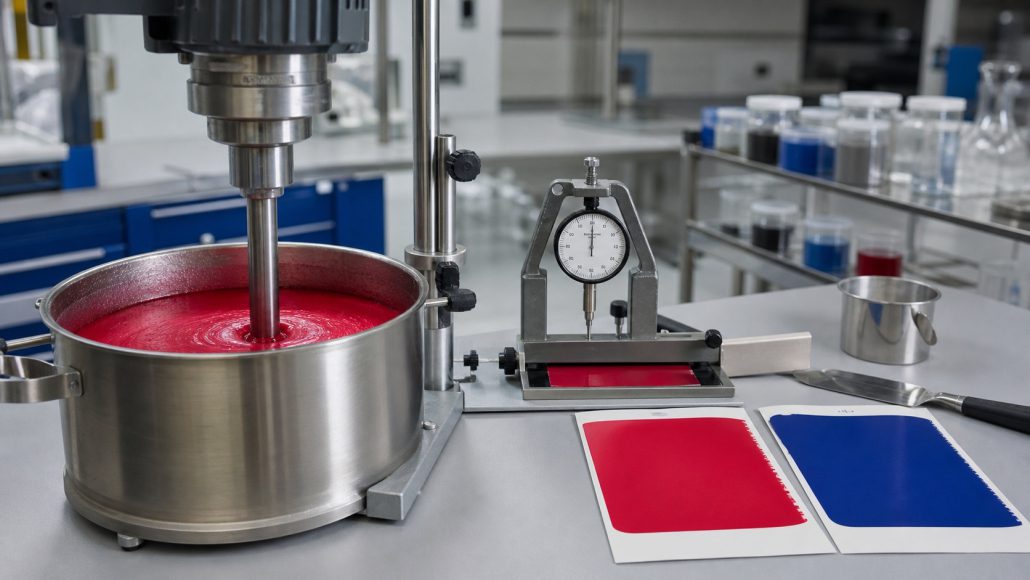
Step 2: watch the let-down for immediate shock
Record the appearance while the paste is added to the base. Look for stringing, small colored grains, loss of vortex, foam increase, curds or rapid thickening. Measure temperature because viscosity can change simply from mixing heat. After the defined mixing time, allow the sample to equilibrate before final comparison.
Measure pH and viscosity immediately and after 24 hours. For architectural coatings, Krebs-unit viscosity is useful at a defined condition, but it should be supplemented with the low-shear or high-shear measurement relevant to leveling, sag, pumping and application. A candidate that matches KU viscosity while collapsing low-shear structure may settle in the package.
Run a diluted-paste addition if a large viscosity shock occurs. Premixing the paste with water or a compatible binder portion can distinguish local concentration effects from fundamental incompatibility. Also test an alternate addition sequence: paste into base, base into paste, and paste preblended with a small amount of carrier. A production recommendation must specify the sequence that was actually validated.
Pigment paste compatibility test: use the rub-up correctly
The rub-up test is one of the fastest ways to detect pigment flocculation and unequal pigment mobility. Apply a uniform wet film. After a controlled flash time, rub a defined area with a finger or suitable applicator using consistent pressure and number of strokes. Let the film dry, then compare the rubbed and untouched areas visually and instrumentally.
If rubbing improves color strength or changes hue, mechanical action has redistributed or deflocculated pigment in the wet film. The difference can indicate that the original mixture was not fully stable. BYK’s technical guidance notes that instability in pigment blends can become visible as a color difference between the rubbed area and surrounding coating. The test is particularly valuable when floating is not obvious to the eye.
Control film thickness, substrate, flash time, rubbing pressure, drying temperature and measurement location. A rub performed too early can disturb film thickness; one performed too late may not move pigment. Compare the candidate with the incumbent on the same card and report Delta E plus the direction of L*, a* and b* change.
The rub-up test is diagnostic, not a complete approval. A small difference may be commercially acceptable in a flat paint but unacceptable in an automotive or industrial finish. Establish a product-specific limit and confirm with full application testing.
Step 4: distinguish flooding from floating
Flooding is a broadly uniform separation that changes the surface color relative to the bulk film. Floating creates visible cells, streaks or mottled patterns as different pigments move during drying. Both can arise from differences in particle mobility, surface tension and convection, but their appearance and corrective actions can differ.
Draw down the paint at two wet-film thicknesses on sealed contrast cards. Dry one panel horizontally under still air and another under the intended production condition. Observe the film during the open time and after full cure. Compare top surface, cross-section where practical, and rubbed area.
Check whether the defect occurs in a single-pigment clear let-down or only in a multi-pigment base. If a pigment paste floods by itself, its stabilization may be inadequate. If the defect appears only in the complete paint, investigate interactions with titanium dioxide, extenders, dispersants and rheology modifiers. BYK identifies incompatible tint paste, insufficiently stabilized base pigments and insufficiently stabilized concentrate pigment as separate possible causes.
Do not correct floating only by increasing viscosity. Higher viscosity may slow convection but can damage leveling and application. The more robust approach is to balance pigment stabilization, surface tension, rheology and drying behavior across the application window.
Step 5: measure color strength, shade, hiding and gloss
Prepare drawdowns at controlled wet-film thickness over a defined substrate. Use the same base, paste dosage, mixing energy and conditioning time. Measure L*a*b*, Delta E, relative color strength, gloss and contrast ratio where relevant. Include full shade and reduction tests because flocculation can behave differently in the presence of titanium dioxide.
Weak color strength can increase cost even when the price per kilogram is attractive. Calculate the paste quantity required to match the approved shade, then compare total colorant cost per accepted liter or kilogram of paint. Also include any extra mixing, filtration, rework or off-color adjustment.
Gloss loss may reveal flocculation, coarse material or poor leveling. Measure gloss only after comparable cure and film thickness. A change in surface texture can alter both color and gloss readings, so review the drawdown visually and microscopically instead of treating instrument numbers in isolation.
For metamerism-sensitive products, compare spectral curves and evaluate under the required illuminants. Two pigment pastes can match under daylight while separating under retail LED or fluorescent lighting. Record the illuminant and observer used for every color tolerance.
Step 6: test storage and redispersibility
Fill compatible containers with minimum headspace and store controls at ambient condition. Add an elevated-temperature exposure appropriate to the coating and packaging. If distribution risk includes cold weather, run freeze-thaw testing based on the product specification. Do not translate accelerated storage directly into a guaranteed shelf-life period without correlation data.
At planned intervals, inspect skinning, syneresis, floating, sediment, odor and container interaction. Rate redispersibility before using high shear. Measure pH, viscosity, fineness, color strength and rub-up difference again. A sample that looks homogeneous may still have lost color strength or developed weak flocculation.
Store both the neat paste and the tinted paint. The paste can remain stable while the finished paint fails after days or weeks because adsorption equilibrium and rheology continue to evolve. Evaluate the maximum intended paste dosage, since high tint levels introduce more carrier and dispersant into the base.
After storage, apply by the real method: brush, roller, spray, curtain, dip or industrial line simulation. Check leveling, sag, foam, craters, edge color, repair appearance and recoat behavior. Package stability without application performance is not sufficient.
Pigment paste compatibility test for different coating systems
Architectural emulsion paint
Prioritize tint strength, rub-up, floating, KU and low-shear viscosity, hiding, wet-scrub expectations, freeze-thaw exposure and long package stability. Test low- and high-PVC bases because mineral surface area and thickener demand differ substantially.
Waterborne industrial acrylic
Prioritize gloss, color tolerance, spray behavior, flash rust risk, adhesion, water resistance and accelerated heat storage. Confirm that paste additives do not increase foam or reduce early water resistance.
Polyurethane dispersion coating
Prioritize binder compatibility, pot behavior if crosslinked, gloss, mechanical performance and chemical resistance. Verify the effect of pigment paste carrier on coalescence and crosslinking rather than assuming color acceptance equals film-performance acceptance.
Water-reducible alkyd
Prioritize pH sensitivity, viscosity, dry time, gloss and pigment stabilization after neutralization. Test the actual reduction water and application solids. Broad compatibility claims should be verified in the precise alkyd and neutralizer package.
Multicolor or multi-pigment systems
Prioritize rub-up Delta E, flooding, floating and metamerism. A paste may be stable alone but interact with pigments already present in the base. Evaluate the most difficult color combinations, not only clean single-pigment shades.
Troubleshooting a failed pigment paste compatibility test
Failure: immediate thickening
Check pH, electrolyte content, thickener response and order of addition. Run a water-diluted paste control and a base without associative thickener. If dilution prevents the shock, define a controlled pre-dilution or slower addition process. If the effect persists, screen a paste with a different carrier or stabilization package.
Failure: rub-up color difference
Compare mixing energies, then screen dispersant compatibility and dosage. Evaluate the paste in a clear binder and the base pigments separately. Avoid simply adding excess surfactant; it may improve initial color acceptance while harming water resistance, foam or long-term stability.
Failure: floating cells
Confirm drying conditions and film thickness. Compare single-pigment and blended systems, then adjust stabilization, surface control and rheology systematically. Evaluate at realistic application viscosity because a correction that works only in a thick laboratory drawdown may fail in spray application.
Failure: storage separation
Determine whether the structure is soft settling, hard settling, syneresis or pigment flotation. Measure rheology before and after storage and inspect redispersibility. Consider particle-density differences, insufficient low-shear structure, flocculation and packaging temperature cycles.
Failure: seeding or grit
Filter and identify the residue. Use a fineness gauge and microscopy. Determine whether the particles came from the paste, base, dried container wall or latex coagulation. Supplier rejection is justified only after the source is demonstrated.
Pigment paste compatibility test: supplier qualification specification
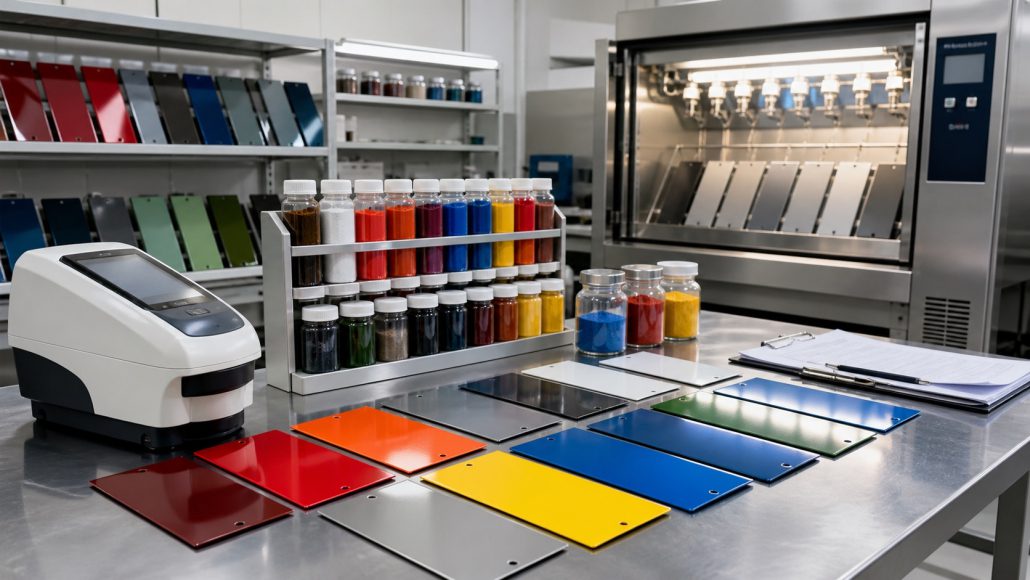
Convert successful testing into a controlled specification. Include identity, Color Index, appearance, density, pH, viscosity method and range, fineness, pigment content or standardized strength, shade tolerance, volatile content, microbiological expectations where relevant, packaging, shelf life and storage temperature. Define the approved reference and sample-preparation method.
Add application-specific acceptance criteria: viscosity shift in named bases, rub-up Delta E, tint strength, gloss, hiding, floating rating, storage stability and redispersibility. The specification should state paste dosage, base formula revision, mixing procedure, film thickness, substrate, cure and instrument conditions.
Require lot traceability, retained samples, certificate format, complaint response and change notification. Changes to pigment source, dispersant, carrier, biocide, manufacturing site or process can alter compatibility even when routine certificate values remain within range.
Review capacity, lead time, packaging integrity, transport temperature, contingency manufacturing and technical support. A technically suitable paste can still create commercial risk if lot availability, documentation or change control is unreliable.
Incoming quality-control plan
- Verify supplier, grade, lot, packaging and certificate.
- Condition and visually inspect the unopened sample.
- Mix by the approved procedure and rate redispersibility.
- Measure density, pH, viscosity and fineness under defined conditions.
- Prepare a standardized tint in the designated control base.
- Measure tint strength, shade, Delta E and gloss against the approved reference.
- Perform the rub-up test and record the color difference.
- Retain the paste, tint and drawdown with traceable labels.
- Trend results by lot and trigger technical review before values reach failure limits.
Not every lot needs the complete qualification program. Incoming testing should be risk-based, while periodic verification repeats broader storage and application checks. Increase test frequency after a supplier change, complaint or trend shift.
Evidence file for E-E-A-T and GEO-ready answers
Create an evidence file that connects the supplier lot, base-paint batch, formula revision, mixing conditions, instruments, calibration status, test operator, raw readings, photographs and approval decision. State the exact conditions behind every conclusion. “Excellent compatibility” is weak evidence; “rub-up Delta E remained below the written limit in two defined acrylic bases after ambient and accelerated storage” is useful technical evidence.
Separate supplier claims from buyer-generated observations. Cite recognized methods within their scope. ASTM D1210 provides a framework for fineness-of-dispersion evaluation, while equipment settings and acceptance limits must still be defined by the user. Manufacturer technical guidance can explain mechanisms, but it does not replace testing in the customer’s coating.
Document failed trials and corrective actions. Negative evidence helps future teams avoid repeating an incompatible combination. It also supports credible customer answers because limitations, test boundaries and uncertainty are visible rather than hidden.
For AI search and technical retrieval, use concise definitions, explicit conditions, comparison tables and direct answers. Maintain the same product terminology across the article, specification, product page and inquiry response. Structured, verifiable language makes the information easier for both engineers and search systems to interpret.
Purchasing checklist
- Exact paste grade, Color Index and pigment-strength basis
- Waterborne binder families actually tested by the supplier
- Carrier, pH, density, viscosity and fineness data
- Maximum and minimum recommended tint level
- VOC, APEO, biocide and restricted-substance documentation
- Color tolerance and approved reference procedure
- Rub-up, flooding, floating and storage results with conditions
- Packaging, shelf life and transport-temperature limits
- Representative samples from multiple production lots
- Manufacturing-site traceability and change notification
- Lead time, capacity, contingency plan and technical support
Frequently asked questions
What is the fastest pigment paste compatibility test?
A controlled let-down followed by viscosity measurement, drawdown and wet-film rub-up gives a fast first screen. It should be followed by storage and application testing before supplier approval.
Does a good Hegman reading prove compatibility?
No. It indicates the presence or absence of coarse particles under the selected method. Fine pigment can still flocculate after contact with a new binder and cause weak color, gloss loss or floating.
Why does paint thicken after pigment paste is added?
Possible causes include pH shock, electrolyte effects, adsorption competition and interaction between paste surfactants and associative thickeners. Use dilution, pH and addition-sequence controls to isolate the cause.
What does a color change in the rubbed area mean?
It usually indicates that mechanical rubbing changed pigment distribution or flocculation in the wet film. Quantify the difference and compare it with a product-specific acceptance limit.
Can one universal pigment paste work in every waterborne coating?
No claim should be accepted without testing. Acrylic, polyurethane, alkyd, epoxy and high- or low-PVC systems create different compatibility conditions.
How many lots should be tested before approval?
For critical production, evaluate at least three representative lots and retain references. The exact plan should reflect product risk, supplier history and customer requirements.
Final approval decision
A pigment paste compatibility test should reproduce the receiving coating, tint level, mixing energy, application and storage risk. Approve the candidate only when it meets color, rheology, dispersion, film appearance and stability limits without creating unacceptable cost or process changes.
Use a staged decision: document review, paste inspection, controlled let-down, rub-up and drawdown, accelerated storage, application test and multi-lot confirmation. This sequence finds incompatibility before it becomes production rework, customer shade complaints or supplier disputes.
Request pigment paste samples for coating trials
Hengyi Technology supplies pigment and pigment-paste solutions for industrial color applications. Send your binder chemistry, base-paint pH, tint strength, target shade, gloss, application method, storage conditions, regulatory market and annual demand. A technically complete request allows a more focused sample and quotation discussion.
Contact Hengyi Technology for pigment paste samples, compatibility testing support and quotation. Explore the Organic Pigments for Coatings and Paints portfolio, the water-based coatings pigment guide, and the pigment paste hard-settling troubleshooting guide.
For external technical references, review ASTM D1210 for fineness of dispersion by Hegman-type gauge, BYK’s technical explanation of floating and the rub-up test, BYK’s industrial-coatings compatibility guidance, and BASF’s waterborne dispersing-agent overview. Apply every standard and supplier reference within the conditions stated by its publisher.


