
Pigment Paste for Flexographic Printing Inks: Viscosity, Filtration, Foam, Color Strength and Supplier Qualification
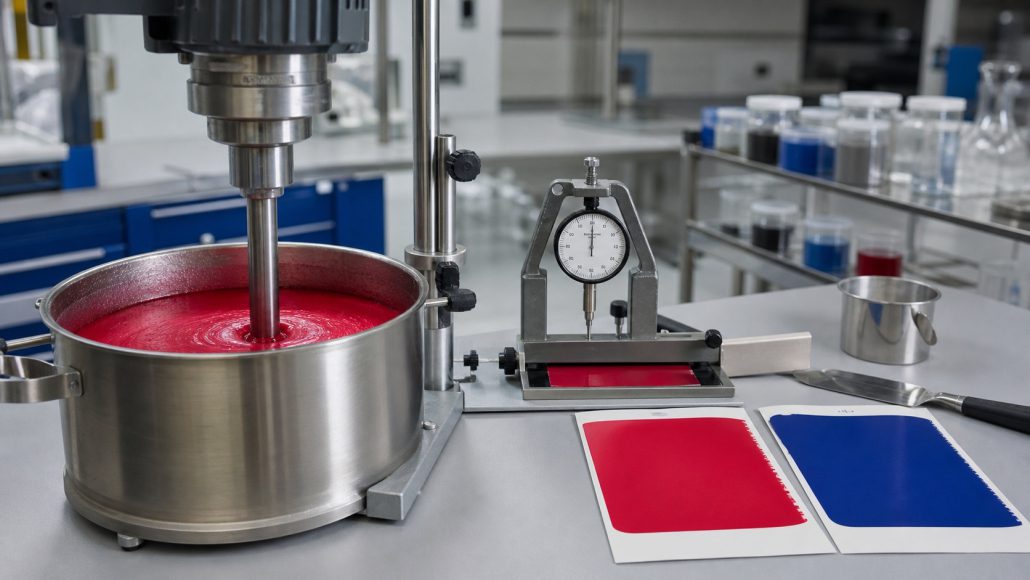
Quick Answer: Pigment paste for flexographic printing inks must be qualified for the complete press system, not just shade. Compare candidate lots for viscosity at press temperature, filtration pressure, foam release, fineness of grind, color strength, rub resistance, storage stability, anilox transfer and supplier consistency. Run a controlled drawdown and press simulation using the actual resin, solvent or water system, anilox volume, drying conditions and final filter.
Flexographic ink manufacturers face a narrow operating window. A paste can look correct in a beaker and still foam in circulation, plug a filter, overload an anilox cell, dry on the plate, or change viscosity during a long print run. This procurement guide connects laboratory QC to press performance and gives buyers a defensible route to sampling, approval and an inquiry.

Why flexographic ink is different from general coatings
Flexographic inks are transferred through an anilox roll, plate, substrate and dryer at high speed. Viscosity, surface tension, foam, drying and wetting therefore interact with the colorant. A paste that is acceptable for a high-build coating may be too viscous for anilox metering or may contain a coarse tail that accumulates in circulation. Qualification should specify the press speed, anilox volume, substrate, drying profile and color tolerance.
Water-based, solvent-based, UV-curable and low-migration packaging inks require different compatibility screens. The carrier, dispersant, resin and additives can change the paste’s rheology and filtration behavior. A supplier should provide test conditions, not a single unqualified viscosity number.
Quick Answer: Pigment paste tinting strength should be tested by comparing a candidate batch with an approved reference paste in the same controlled coating formula, at equal pigment or equal paste dosage, using identical mixing energy, film thickness, drying conditions, and color-measurement settings. Measure relative tinting strength together with L*, a*, b*, delta E, viscosity, fineness of grind, gloss, opacity, and storage stability. A batch should not be approved on visual shade alone. The best incoming-quality specification connects laboratory results with production behavior, defines repeatability and acceptance limits, and requires investigation whenever a change in strength is accompanied by rheology, dispersion, or compatibility drift.
For a coatings manufacturer, pigment paste is not merely a color ingredient. It affects shade accuracy, hiding power, gloss, viscosity, line speed, rework, and the cost of every finished kilogram. Small changes between lots can force operators to add extra paste, adjust several colorants, extend mixing time, or hold production while the laboratory investigates. A well-designed pigment paste tinting strength test therefore protects both product quality and purchasing economics.
This guide explains how coating laboratories, quality-control teams, and buyers can build a practical batch-consistency program. It covers sampling, reference standards, test formulas, drawdown preparation, spectrophotometer settings, strength calculations, common sources of error, accelerated storage, supplier documentation, and acceptance decisions. The purpose is not to prescribe one universal method, but to show how to create a controlled method that is relevant to the customer’s actual coating system.
Why Tinting Strength Matters in Pigment Paste Purchasing
Tinting strength describes how effectively a colorant changes the color of a defined white or colored system. In practical coating work, it is usually expressed as a relative percentage against an approved reference batch. A result of 100% means the candidate produces the same defined color effect as the standard under the specified test conditions. A value above or below 100% indicates a stronger or weaker result, although the exact calculation depends on the instrument software and method.
Strength directly affects dosing cost. If a new lot is five percent weaker, production may need approximately five percent more paste to reach the same target, but the correction is not always perfectly linear. More paste can also introduce additional water, solvent, dispersant, humectant, resin, or surfactant into the coating. These carrier components may change viscosity, dry time, water resistance, foam, gloss, or film integrity. A strength difference can therefore create both a color correction and a formulation change.
Strength is also an early warning signal. A shift may reflect pigment-content variation, incomplete dispersion, particle-size change, different surface treatment, excess moisture, incorrect letdown, sedimentation, or a raw-material substitution. The laboratory should evaluate strength together with shade and physical properties so it can distinguish a normal manufacturing variation from a meaningful change in product identity or process capability.
Tinting Strength Is Not the Same as Shade or Delta E
Three related measurements are often confused. Shade describes the color position and undertone of the paste after it is incorporated into a specified system. Delta E describes the numerical color difference between the candidate and reference under defined measurement conditions. Tinting strength estimates the relative coloring power. A candidate can have acceptable strength but an unacceptable undertone. It can also match visually at one dosage while requiring more material than the reference.
Consider two blue pigment pastes. The candidate may be 102% in strength but slightly greener than the standard. Reducing its dosage can correct depth, yet the green undertone remains. In a single-color coating this may be visible; in a multi-pigment formula it may require extra red or violet colorant. The final correction cost and metamerism risk can be larger than the apparent two-percent strength advantage.
For this reason, a report should include relative strength, L*, a*, b*, delta E, and a visual assessment under agreed lighting. If the coating will be sold in multiple markets, evaluate the relevant illuminants and observer settings. A pass/fail decision based on one delta E value without examining strength, hue direction, and production correction can hide commercially important differences.
Build the Test Around the Actual Coating System
A pigment paste can behave differently in acrylic, polyurethane, alkyd, epoxy, vinyl, or silicone-modified coatings. Waterborne and solventborne systems place different demands on wetting agents, resin compatibility, pH, and solvent balance. Even within waterborne acrylics, a change in emulsion type, neutralizer, thickener, or surfactant can alter color development and flocculation.
The most useful quality-control formula is therefore a simplified but representative version of the customer’s production system. It should be sensitive enough to reveal changes but stable enough to reproduce. A white-base letdown is common because titanium dioxide creates a measurable tint and helps expose undertone. For transparent pigments, a clear-base or masstone drawdown may be added to evaluate transparency, haze, and chroma.
Document every component by supplier, grade, and lot-control policy. Fix the paste-to-base ratio, solids, mixing sequence, container geometry, blade or mixer type, speed, time, and temperature. If the method changes whenever an operator runs the test, the resulting variation may be larger than the difference between pigment paste lots.
Recommended Test Matrix
| Test | What it reveals | Typical comparison |
|---|---|---|
| Masstone drawdown | Full shade, gloss, transparency, surface defects | Candidate versus retained reference |
| White tint | Tinting strength and undertone | Fixed paste-to-white-base ratio |
| Strength-adjusted tint | Residual hue difference after depth correction | Candidate dosage adjusted to reference strength |
| Fineness of grind | Agglomerates and dispersion consistency | Hegman or micrometre reading |
| Viscosity and flow curve | Rheology drift and compatibility | Defined temperature, spindle, speed, and time |
| Rub-up test | Flocculation and color development | Rubbed area versus untouched film |
| Gloss and haze | Particle and dispersion effects on appearance | Specified angle and film thickness |
| Storage stability | Settling, syneresis, viscosity and shade drift | Ambient and accelerated aging |
| Compatibility ladder | Robustness across customer bases | Several resin or additive systems |
Sampling: The First Control Point
No laboratory method can compensate for a poor sample. Pigment paste can separate during transport or storage, especially when the product has a wide density difference between pigment and carrier. Taking material from the surface of an unmixed drum may produce a weak sample, while taking only settled material from the bottom may produce an artificially strong result. Sampling instructions must reflect packaging size and the supplier’s recommended homogenization procedure.
Before opening, record product code, lot number, manufacturing date, package condition, seal status, and storage temperature. If the specification allows remixing, define the equipment and time. Avoid entraining excessive air. For large containers, a composite sample from several locations may be necessary. For routine deliveries, establish a statistically justified number of packages to sample rather than choosing only the easiest drum.
Place the sample in a clean, compatible, tightly closed container and label it immediately. Retain enough material for confirmation testing and supplier investigation. A reference lot should be stored under controlled conditions, protected from freezing, heat, evaporation, and contamination. Replace the reference before aging changes its viscosity or color performance.
Reference Standards and Control Samples
The approved reference should represent a lot that performed successfully in both laboratory and production trials. It should not be an idealized laboratory sample that was never used at scale. Assign a unique reference number, approval date, storage condition, and replacement date. Keep sealed portions so repeated opening does not change water or solvent content.
A daily control sample can help distinguish instrument or operator problems from material variation. Test the control before evaluating incoming lots. If the control falls outside its established range, stop and investigate the method rather than rejecting the delivery. Possible causes include an aging white base, incorrect weighing, a damaged film applicator, dirty glass panels, instrument calibration drift, or changes in room temperature and humidity.
When a reference supply becomes low, bridge the old and new standards with multiple replicate tests. Do not simply nominate the latest passing lot. Record the relationship between standards so historical data remain interpretable. For critical automotive, architectural, or industrial coatings, statistical control charts can show whether the method and product remain centered over time.
Step-by-Step White-Tint Test
- Condition materials. Bring the pigment paste, white base, panels, and equipment to the defined laboratory temperature. Gently homogenize according to the method.
- Calibrate balances and instrument. Use a balance appropriate for the small dosage. Calibrate the spectrophotometer with its current certified tile or standard.
- Weigh the white base. Use one homogeneous batch for the candidate and reference. Record actual weights, not only nominal targets.
- Add pigment paste. Weigh the defined amount directly into the base. Avoid loss on tools or container walls.
- Mix consistently. Fix mixer type, blade diameter, speed, time, container size, and batch volume. Scrape the walls only at defined stages.
- Deaerate if required. Use the same rest time or vacuum treatment for every sample.
- Prepare drawdowns. Apply candidate and reference side by side with the same applicator, substrate, direction, pressure, and wet-film thickness.
- Dry or cure. Control flash time, temperature, humidity, oven schedule, and panel position.
- Measure. Use the same instrument geometry, aperture, illuminant, observer, specular setting, backing, and measurement locations.
- Report and interpret. Record strength, color values, delta E, visual undertone, gloss, and any surface abnormality.
Mixing Energy and Color Development
A paste that is already well dispersed should normally develop color with moderate letdown mixing. Excessive high-shear mixing can hide compatibility weaknesses or change temperature enough to affect rheology. Insufficient mixing can leave streaks and produce a false low-strength result. The method must use enough energy to distribute the paste uniformly without becoming a second grinding process.
Validate the chosen mixing time by creating a color-development curve. Prepare identical samples at several mixing times and plot strength or delta E. Select a time after the curve reaches a stable plateau. If the result continues changing for a long period, investigate whether the paste is difficult to incorporate, the base is incompatible, or the equipment is inadequate.
Monitor sample temperature because high-speed mixers convert energy into heat. Temperature changes viscosity and can affect flocculation, foam, evaporation, and film leveling. A controlled laboratory mixer with recorded speed is preferable to manual stirring. If manual preparation is unavoidable, method precision must be established with repeated tests by different operators.
Film Preparation and Measurement Conditions
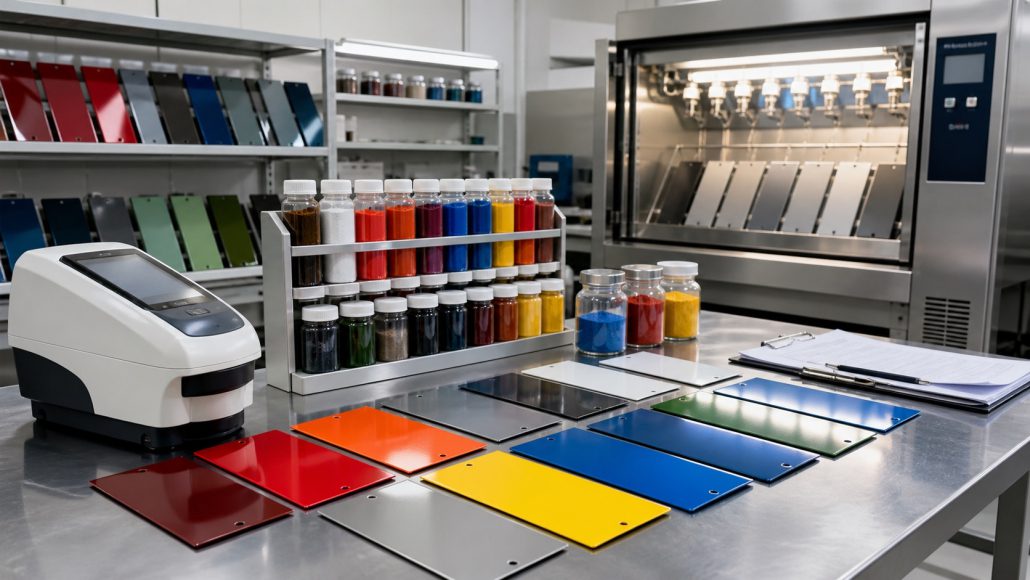
Uneven film thickness can create misleading differences in color, opacity, and gloss. Use clean, flat substrates and a calibrated applicator. The substrate color and porosity must be controlled. For opaque coatings, black-and-white contrast cards allow simultaneous assessment of hiding. For transparent systems, clear film or standardized white and black backings may be needed.
Drying conditions can change color development. Waterborne coatings may show different coalescence and surfactant distribution at low temperature or high humidity. Baking systems require controlled metal temperature, not merely oven-air temperature. Two panels cured in different positions can receive different airflow or heat. Record the conditions and measure only after the defined conditioning time.
Spectrophotometer geometry matters. A sphere instrument with specular included can report differently from a 45/0 instrument or specular-excluded setting. Aperture size should suit the film uniformity. Measure several areas and report the average and spread. If visual assessment is part of approval, use a maintained light booth and trained observers rather than uncontrolled office lighting.
How Relative Tinting Strength Is Interpreted
Many color-measurement programs calculate strength using reflectance data and a Kubelka-Munk relationship, often expressed through K/S values. The exact output depends on pigment behavior, wavelength selection, opacity, and software settings. Laboratories should use one validated calculation and avoid comparing percentages generated by different methods as if they were interchangeable.
A result such as 97% may be acceptable in one application and unacceptable in another. The tolerance should be based on production capability, dosing accuracy, correction cost, and final-product specification. A narrow tolerance has little value if laboratory repeatability is poor. First determine the method’s repeatability and reproducibility, then set an acceptance band that reliably distinguishes normal test noise from product change.
Do not automatically compensate a weak batch and approve it. Review whether its viscosity, shade, dispersion, and storage behavior remain acceptable. A strength-adjusted drawdown is useful: change the candidate dosage to match the reference depth, then compare the remaining hue and appearance. This shows whether a simple dosage correction is technically and economically reasonable.
Fineness of Grind and Dispersion Diagnostics
A grind gauge is a quick screen for coarse particles or agglomerates, but it does not measure the full particle-size distribution. Run the test with a consistent draw speed and interpret both the first scratch pattern and the point of dense particles according to the agreed method. Clean the gauge immediately to prevent dried material from creating false readings.
A passing grind result does not prove complete dispersion. Soft flocculates can break under the gauge blade and still reduce strength or gloss in a coating. Microscopy, particle-size analysis, filtration residue, rub-up, and gloss can provide additional evidence. When strength drops while grind remains unchanged, consider flocculation, crystal change, pigment content, or base compatibility rather than assuming coarse contamination.
For fine industrial finishes, filtration through a defined mesh or screen can reveal hard particles that cause surface defects or spray-gun blockage. Report residue by mass and inspect its character. Dried skin, packaging debris, resin gel, and pigment agglomerates require different corrective actions.
Viscosity, Rheology, and Density
Viscosity is one of the fastest indicators of batch drift, but a single number is meaningful only when the test conditions are fixed. Record instrument, spindle or geometry, speed or shear rate, temperature, sample conditioning, and measurement time. Thixotropic pastes may show different values depending on previous mixing and rest history.
Measure more than one shear condition when rheology affects pumping, dosing, sag, or leveling. A paste can match low-shear viscosity but differ at high shear. Yield stress influences settling and container emptying. Flow curves may help diagnose dispersant balance, pigment-volume changes, or thickener variation.
Density can support mass-to-volume dosing control and detect major composition changes. Solids or nonvolatile content may reveal excess carrier or evaporation. Together with strength, these tests help determine whether a result reflects pigment concentration or color-development efficiency. For example, low strength with low solids suggests dilution, while low strength at normal solids may indicate dispersion or pigment-quality change.
Rub-Up, Flooding, Floating, and Flocculation
The rub-up test compares a freshly rubbed area with the untouched film. A large color difference suggests that mechanical action has changed pigment distribution or deagglomeration. In multi-pigment coatings, selective flocculation can produce flooding, floating, or shade drift during drying. The result depends on film timing, rubbing procedure, and coating rheology, so the method must be standardized.
Flocculation can reduce color strength even when the pigment paste itself passes its release tests. The interaction between paste dispersant and coating resin, surfactant, thickener, or coalescent may be responsible. Test the paste in representative bases and perform a compatibility ladder when it will be sold to diverse customers.
If a new batch shows a larger rub-up difference than the standard, investigate before correcting the shade. More dispersant is not always the answer; excess dispersant can reduce water resistance, increase foam, or destabilize other pigments. Compatibility work should consider pigment surface area, dispersant chemistry, pH, ionic strength, and the order of addition.
Storage and Accelerated Stability Testing
Incoming tests describe the sample at one moment. Pigment paste must also remain usable during storage and after incorporation into a coating. Retain samples at the recommended storage temperature and inspect for settling, syneresis, skin, odor, microbial change, viscosity drift, and color change. Record whether sediment is easily redispersed or forms a hard compact layer.
Accelerated heat storage can help compare batches, but it does not perfectly predict real shelf life. Select a temperature that stresses the system without creating an unrealistic failure mechanism. Freeze-thaw testing is important only when the product may encounter low-temperature transport or storage. Use defined cycles and allow samples to equilibrate before evaluation.
After aging, repeat strength, shade, viscosity, grind, and compatibility tests. A paste can look visually stable yet lose color development or increase flocculation. Include a control reference in every aging study. If the candidate and reference age differently, the result is more meaningful than an isolated pass/fail observation.
Typical Acceptance Criteria
Acceptance limits must be agreed between supplier and customer and linked to the application. A routine specification may include identity, appearance, relative tinting strength, shade difference, delta E, viscosity range, fineness of grind, nonvolatile content, density, pH for waterborne products, and storage stability. Sensitive applications may add gloss, haze, filtration residue, rub-up, heavy metals, or application-specific resistance tests.
A useful specification states the method beside every limit. “Viscosity: 2,000–3,000 mPa·s” is incomplete without temperature, spindle, speed, conditioning, and instrument. “Delta E below 1.0” is incomplete without formula, illuminant, observer, geometry, and surface condition. “Strength 100 ± 5%” is incomplete without the reference, base, dosage, and calculation.
Use warning limits as well as rejection limits where appropriate. A value inside the formal specification but moving steadily toward one boundary may signal process drift. Trend charts can reveal gradual changes before customers experience failure. A supplier should investigate recurring near-limit results instead of relying on the fact that each individual lot technically passed.
Measurement-System Analysis and Laboratory Precision
Before setting narrow tolerances, determine how much variation comes from the method. Ask several trained operators to prepare repeat samples from the same homogeneous paste and reference. Repeat the work on different days. Analyze variation from weighing, mixing, drawdown, curing, and instrument measurement. The objective is to understand the smallest material difference the laboratory can reliably detect.
If repeatability is poor, improve the method before tightening the product specification. Common improvements include larger test batches to reduce weighing error, automatic mixing, temperature control, fixed drawdown equipment, better panel conditioning, and multiple measurements. Training and clear photographs of acceptable film quality can also reduce operator differences.
Instrument maintenance is equally important. Follow calibration schedules, keep optical areas clean, monitor standard tiles, and document software settings. Color data generated after changing instrument geometry or calculation parameters should not be merged with historical data without a bridging study.
Troubleshooting Out-of-Specification Results
Low strength with normal shade direction
Check weighing, reference condition, paste homogenization, solids, pigment content, and mixing energy. Repeat with retained samples. If the difference is confirmed, evaluate whether dosage correction affects coating properties and cost.
Strength passes but undertone shifts
Review pigment chemistry, crystal form, particle size, raw-material source, and dispersion conditions. Prepare a strength-adjusted comparison and evaluate metamerism. A shade correction may require another colorant and create downstream complexity.
High viscosity and low strength
Consider flocculation, excess surface area, incorrect dispersant level, evaporation, microbial change, or low compatibility. Check rub-up, solids, pH, microscopy, and storage history.
Coarse particles or filtration residue
Inspect residue to identify pigment agglomerates, dried skin, resin gel, or foreign contamination. Review milling, screening, packaging cleanliness, and drum sealing. Do not assume additional customer mixing will solve hard contamination.
Laboratory result passes but production fails
Compare scale, shear, order of addition, temperature, water or solvent quality, and aging time. The laboratory formula may be too forgiving or unrepresentative. Update the qualification method using production evidence.
Supplier Qualification for Pigment Paste
A supplier should demonstrate control of raw-material identity, pigment loading, dispersion, carrier composition, filtration, filling, and traceability. Request a technical data sheet, safety data sheet, sample certificate of analysis, regulatory declarations, shelf-life statement, storage guidance, and change-notification policy. Confirm whether results on the COA are actual lot measurements or standard specification statements.
Audit questions should cover batch size, milling equipment, endpoint control, cleaning, contamination prevention, retained samples, calibration, nonconforming-material handling, and complaint investigation. Ask how the supplier manages changes to pigment source, dispersant, biocide, resin, water quality, solvent, and packaging. A seemingly minor change can affect coating compatibility.
Qualification should include at least three representative lots when the application is critical. Run laboratory tests and one or more production trials. Record dosing accuracy, mixing time, filtration, shade adjustment, line cleaning, yield, and finished-film performance. Approve the grade only after technical, quality, supply, and commercial requirements are all satisfied.
Purchasing Checklist
- Define the exact pigment paste grade, color index where applicable, carrier type, and intended coating system.
- Specify relative tinting strength method and acceptance band against an approved reference.
- Define shade, delta E, undertone, and visual-lighting requirements.
- Record viscosity method, fineness, solids, density, pH, and storage requirements.
- Confirm packaging, net weight, batch size, shelf life, and transport-temperature limits.
- Request lot-specific COA, SDS, TDS, regulatory declarations, and traceability.
- Require advance notification for pigment, dispersant, carrier, process, site, or packaging changes.
- Evaluate total color cost at equal final shade, not only price per kilogram of paste.
- Check capacity, lead time, safety stock, minimum order, and complaint-response process.
- Retain approved and incoming samples under controlled conditions.
Frequently Asked Questions
What is a good tinting-strength tolerance for pigment paste?
There is no universal tolerance. Many industrial methods use a range around the approved reference, but the correct limit depends on laboratory precision, coating sensitivity, dosage system, correction cost, and final-product tolerance. Establish method capability before agreeing on the band.
Can delta E replace tinting-strength testing?
No. Delta E measures total color difference under defined conditions, while strength estimates coloring power. Two samples can have similar delta E but different strength and undertone. Report both when batch economics and shade correction matter.
Should testing use equal paste weight or equal pigment solids?
Equal paste weight reflects the delivered product and normal dosing. Equal pigment solids can help diagnose concentration effects. For routine receiving inspection, use the agreed commercial basis and add solids data when investigation is needed.
Why does strength change after storage?
Settling, flocculation, evaporation, microbial activity, dispersant redistribution, temperature history, or incomplete remixing can change apparent strength. Repeat testing after controlled homogenization and compare viscosity, solids, and grind.
Is a Hegman grind test enough to approve pigment paste?
No. It is useful for coarse particles but does not fully describe particle distribution, soft flocculation, strength, shade, gloss, compatibility, or storage stability. It should be one part of a broader release method.
How many batches should be tested during supplier qualification?
For a critical coating, three or more representative production lots provide better evidence than one optimized sample. Include normal manufacturing variation and complete at least one realistic scale-up trial.
Can a weaker lot be accepted with a price adjustment?
Only after technical review. Extra paste changes carrier contribution, viscosity, drying, water or solvent balance, and inventory usage. Calculate total correction cost and confirm the finished coating remains within specification.
What information should be sent with a pigment paste inquiry?
Provide the target shade, binder, waterborne or solventborne system, pigment-paste dosage, curing conditions, film requirements, current problem, test methods, annual volume, packaging preference, and regulatory market. This allows a supplier to recommend and sample the correct grade.
Technical and Commercial Evaluation With HengyiTek
HengyiTek supports coating manufacturers and distributors that need consistent pigment paste performance, documented quality control, and practical sample qualification. Our discussions begin with the customer’s coating chemistry, shade target, processing equipment, viscosity window, durability requirements, and receiving-test method. This application information is more useful than selecting a paste by color name alone.
For related information, review the HengyiTek product portfolio, our pigment paste product information, and our guide to pigment paste compatibility testing for waterborne coatings. General colorimetry terminology and international measurement work can be referenced through the International Commission on Illumination.
Request a Sample and Batch-Consistency Review
Send HengyiTek your white base or resin type, target color, current paste, test ratio, tinting-strength method, viscosity requirement, application process, annual demand, and any batch-consistency problem. We can discuss candidate grades, arrange samples, and help structure a side-by-side evaluation. For the fastest technical response, include your approved reference data, drawdown conditions, instrument settings, and photos or measurements from the failed batch.
Flexographic press simulation
After laboratory tinting-strength testing, run a press-relevant simulation. Circulate the ink through a representative pump, filter, hose and anilox or cell geometry for a defined time. Record inlet and outlet viscosity, temperature, pressure, foam height, filter differential pressure and shade at the beginning and end. Print a solid patch, fine text, reverse type and a screened tint. Inspect pinholes, mottle, dirty print, streaks and drying on the plate.
Use an approved paste as the control and compare at equal color strength, not only equal mass. If the candidate reaches color at a lower dosage, calculate the effect on viscosity, drying, cost per printed square meter and filter loading. Retain printed samples for rub, scuff, migration and storage review.
Supplier RFQ for flexographic pigment paste
- Ink chemistry and resin or binder system
- Water, solvent, UV or low-migration application
- Target shade, color strength and ΔE limit
- Press speed, anilox volume, substrate and dryer profile
- Viscosity range at test temperature and shear rate
- Fineness, filterability, foam tendency and storage stability
- Recommended dosage, let-down sequence and dilution method
- CoA, SDS, restricted-substance statement and change control
- Sample quantity for lab, pilot press and customer approval
- Lead time, lot traceability, technical support and inquiry contact
FAQ for buyers
What viscosity should a flexographic pigment paste have?
There is no universal value. Set a range for the actual ink system and measure at a defined temperature and shear condition. The final ink, not the paste alone, must stay inside the press window.
How can foam be reduced?
Check dispersant, surfactant, pump shear, return-line design and defoamer compatibility. Test the candidate in circulation; a beaker shake test is not enough.
Why can an ink filter plug even when fineness passes?
Hard agglomerates, gels, dried skins or contamination may form during storage or let-down. Combine grind gauge, pressure-rise, retained-residue and aging tests.
Inquiry CTA
Send Hengyi Technology your pigment type, carrier, resin, target color, press speed, anilox volume, filter rating and annual demand. We can recommend pigment paste candidates, arrange samples, review press data and support supplier qualification.


